
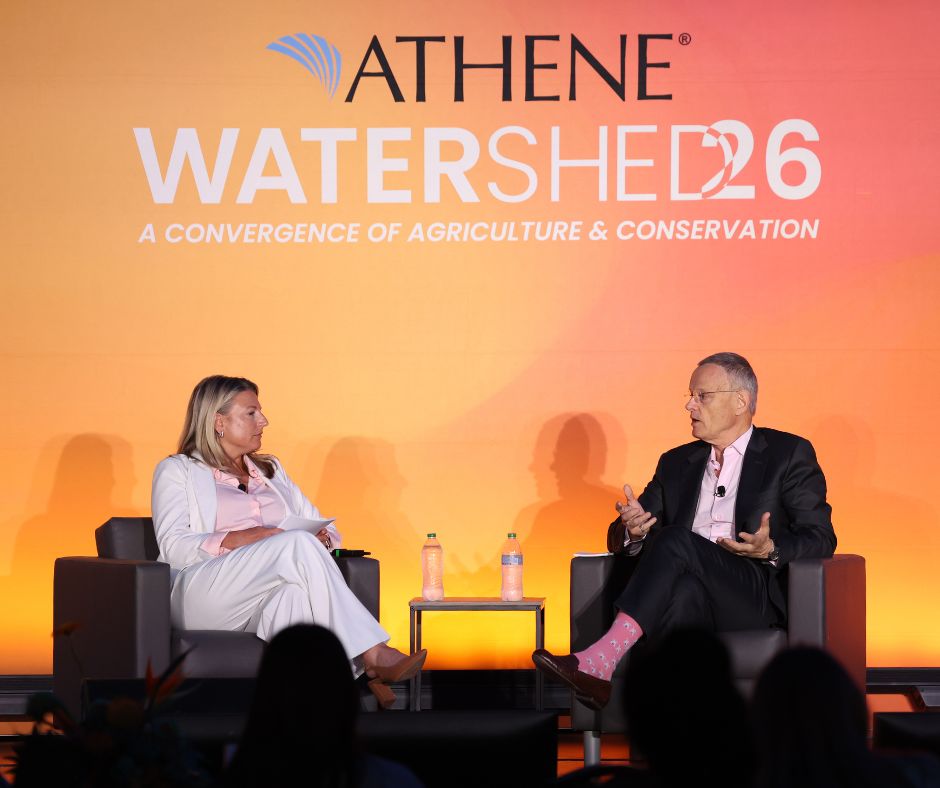
Athene Watershed26 focused on incubating innovative solutions, powerful funding mechanisms, and voices for change to improve Iowa’s water quality.
By Dan Looker
Des Moines, Iowa, and its suburbs sprawl outward from the confluence of two river systems, the Des Moines and Raccoon. In the week before the nation’s 250th Independence celebration and 183 years after the U.S. Army built an outpost along those riverbanks, about 300 visitors and residents gathered at a conference center up the hill from the long-gone fort.
They had arrived from some 20 states to discuss the rivers’ dissolved nitrates and what to do about it. They included scientists, farmers, government conservation experts and businesspeople.
Five paths to change
The conference focused on five water quality themes – dynamic partnerships, emerging voices, finance solutions, science and data, and stacked benefits of conservation – as a way to address Iowa’s biggest water quality challenge.
The issue of upstream nitrate loss isn’t news to the 750,000 residents of the greater Des Moines metro, including many who’ve had to stop lawn watering for the second summer in a row. The ban, now lifted, was implemented because Central Iowa Water Works nitrate removal system couldn’t keep up with higher summer demand and a spike in river nitrates above EPA limits. In response, the state government has allocated more funds for conservation practices upstream in the Raccoon River watershed and for increasing the capacity of the water works’ nitrate filtration.
In one breakout session, “Ask a Farmer: Debunking Common Misconceptions,” farmer and seed dealer Dean Sponheim splashed a bit of realism into the proceedings.
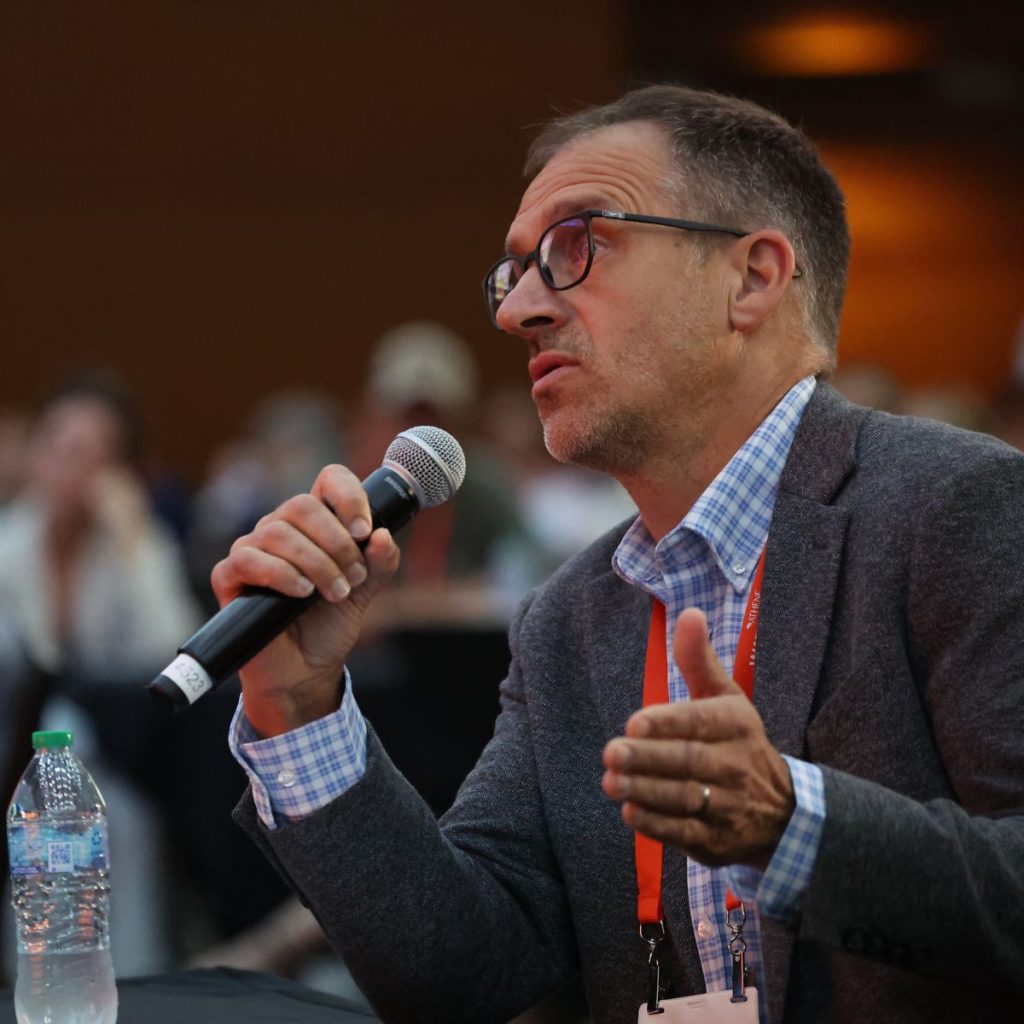
“All this stuff is going to take at least 20 years to do it. I’m hoping we can still do it voluntarily. And that we have enough time for that,” he said at a breakout session dubbed “Ask a Farmer: Debunking Common Misconceptions,” moderated by Rebekah Jones of the Iowa Agriculture Water Alliance.
How to reach middle adopters with cover crops
Sponheim is hardly a naysayer. He started reducing tillage on his own farm in 1999 and began using cover crops—which reduce nitrate runoff—in 2014. With his son and a business partner, he sells cover crop seed and other services to farmers seeking better soil and water conservation. He is on the Rock Creek Advisory Board—the first in the state to have a watershed plan for lowering nitrates under the Iowa Nutrient Reduction Strategy. And he donates much time to traveling the state spreading the word about on-farm conservation at events and conferences like this one.
Sponheim, though a realist, is also optimistic.

Sponheim estimates that half of the acres in his northern Iowa neighborhood are no longer tilled or are planted with tillage only in narrow strips. But he said it has taken 20 years to change tillage practices, and it could take another 20 to adopt cover crop
Most farmers who have planted cover crops at this point (about 17% based on NREC data) are what conservationists call “early adopters”; they’re more willing to take risks or be the first to try.
This is something conservation professionals are grappling with. How can they capture the more resistant or risk-averse farmers?
“I do more counseling than I do seed sales,” Sponheim said.
Even when growers want to make changes, they can be afraid of failure or what the neighbors will think. Sponheim urged those seeking farming changes to be patient and listen to each farmer’s concerns.
Being more efficient with edge-of-field practices
Another breakout session, with the title, “Investments Upstream: Rethinking Conservation Intervention Strategies,” looked at how farmer participation in projects like edge-of-field nitrate removal can be improved.
Edge-of-field practices – bioreactors and saturated buffers – require few changes from farm operators. They clean water by diverting it through microbe-rich soils or woodchips. The microbes naturally convert nitrate to gas.
While these are “easy” solutions because they don’t require in-field changes by the farmer, getting funding for them can be complicated.
John Swanson, water resources planner for Polk County Public Works, and his staff of conservationists were able to simplify getting funding and lining up contractors to build edge-of-field projects. The model – which targets whole neighborhoods at a time – became known as “batch and build.”
Through batch and build, the county funds the whole practice and does all the complicated paperwork for the farmer. They’ve used more than 40 different sources of funds.
“It’s our goal to understand all of those rules,” he said.
Relationships are the key
Because of the batching process, it can seem as if edge-of-field practices are a quicker solution compared to cover crops, especially with Sponheim’s comment that it may take 20 years to expand cover crop adoption.
But edge-of-field work still requires relationships. And relationships take time.
“You have to build trust,” Swanson said. “…and it’s a process you have to go through….and sometimes it’s a slow process.”
Swanson and other speakers on the panel said they’ve worked with farm organizations like Practical Farmers of Iowa and conservation agronomists at Heartland Co-op to reach farmers before beginning that process.
It helps them to build trust with farmers who may be skeptical or worried about how edge-of-field practices will impact their drainage (It’s a common myth that they impair drainage functionality).
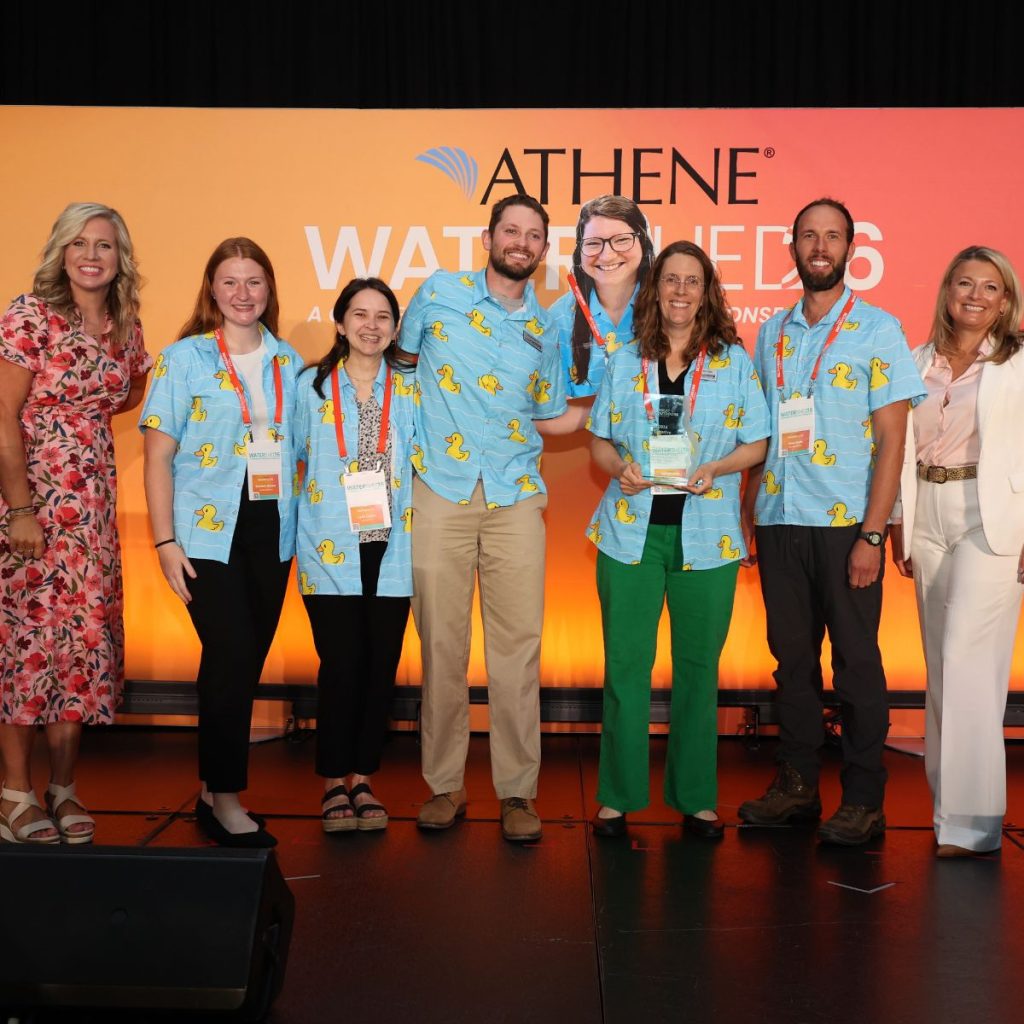
The Heartland Co-op conservation agronomy team was recognized with the Group Creative Conservationist Award from the Great Outdoors Foundation. This was in part due to their batch and build work. According to their website, the team’s impact includes 410 outlets treated with edge-of-field practices and 312,754 acres of cover crops seeded to date,
Polk County has now expanded into facilitating construction of wetlands. Before launching that effort, Swanson and his staff spent a year learning the rules for cost share programs for wetlands.
An abundance of resources to learn from
Breakout sessions at Athene Watershed26 also included one called “Who’s Who & What’s What,” which offered resources for farmers trying to navigate the maze of state, federal and private programs farmers can use to save soil and clean water:
–The Conservation Technology Information Center in Burlington, Iowa offers an on-line searchable database of programs—the Conservation Connector at connector.ag
–The Iowa Agriculture Water Alliance offers a “Conservation Compass” that allows growers to find public and private cost share sources available in Iowa. IAWA communications director Rebekah Jones, was inspired to create it after helping her own family look for conservation funding.
–Practical Farmers of Iowa conducts on-farm research led by its members, educational field days, and technical and financial assistance for cover crops.
–The Rodale Institute’s Midwest Organic Center conducts research trials on its farm near Marion, Iowa and offers free consulting services to farmers transitioning to organic production.
–USDA’s Natural Resource and Conservation Service was represented by Clint Miller, the district conservationist for Polk County. Others working in conservation regard NRCS as the Cadillac of cost share but the red tape can be daunting. Miller acknowledged the challenge but said that once your farm is in the system, applying for cost share from programs like EQIP (the Environmental Quality Incentives Program) is less difficult. “Come into the office and have someone help you,” he said.
Convergence: Accelerating conservation startups
Those attending the conference had a chance to vote for the most innovative tech startup venture in a competition called “Convergence: The Conservation Ag Accelerator.” The winner of the $50,000 prize was Upside Robotics, Inc., based in Waterloo, Ontario.
The company uses AI-driven robots to move through rows of corn, applying microdoses of nitrogen fertilizer 24/7 throughout the growing season. It cuts nitrogen use by fertilizing at the root zone late in the season, when corn needs it most, but larger machinery can’t get into the field. Upside says it reduces fertilizer use by up to 70% with no effect (or even a slight boost) on yields. It charges $250/acre to use the robots.
IAWA partner, Agri-Drain, sponsored the competition and helped judge. Agri-Drain is a local expert in conservation entrepreneurship. It was founded in 1976 and has since won awards for its innovative drainage designs and efforts to expand conservation drainage.
In the short run, progress depends on the farmers doing the work.
The moderator, Rebekah Jones of IAWA, summed it up during the “Ask a farmer” panel.
“We have all of the solutions that we need,” she said. “We have wetlands, we have cover crops. We have bioreactors, saturated buffers. We have these tools, and now we just need to increase them on our landscape. So thank you, guys, for being the risk takers, for doing it first.”
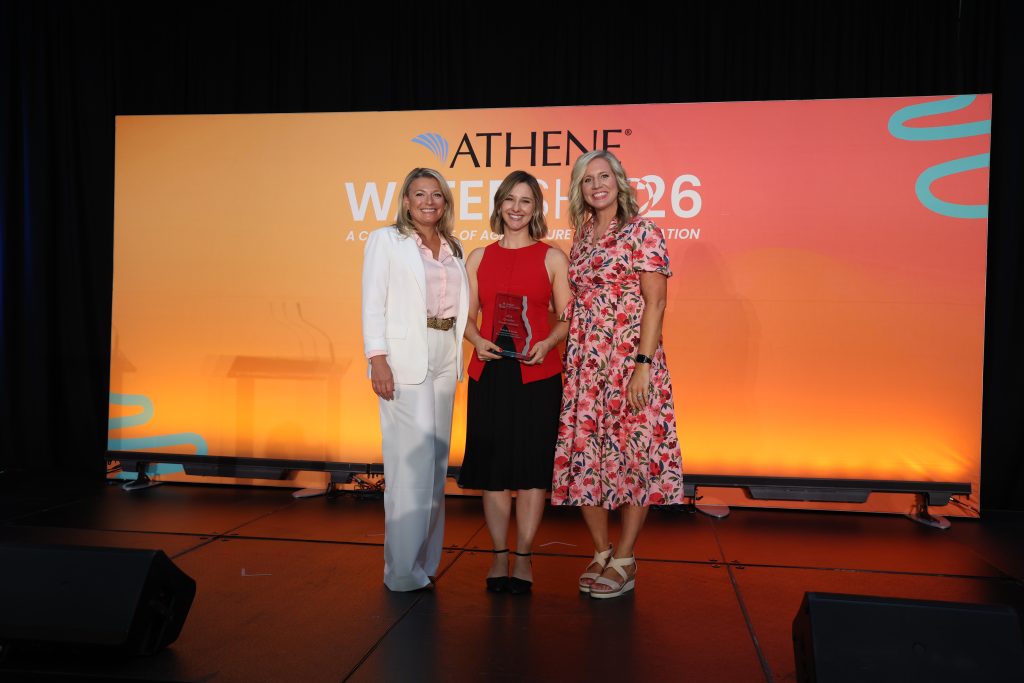
Jones received the individual Creative Conservation Award from GOF for developing “widely used digital tools and strategies that improve farmers’ access to conservation funding and strengthen stakeholder coordination across Iowa,” according to the group’s announcement in June.
The primary sponsor of the conference was Athene, a West Des Moines-based financial services company. Other major sponsors included Google, Meta, Agri Drain, CoBank, Hubbell Realty Company, and Syngenta. The complete list is here: https://greatoutdoorsfoundation.org/about/events/watershed26/