
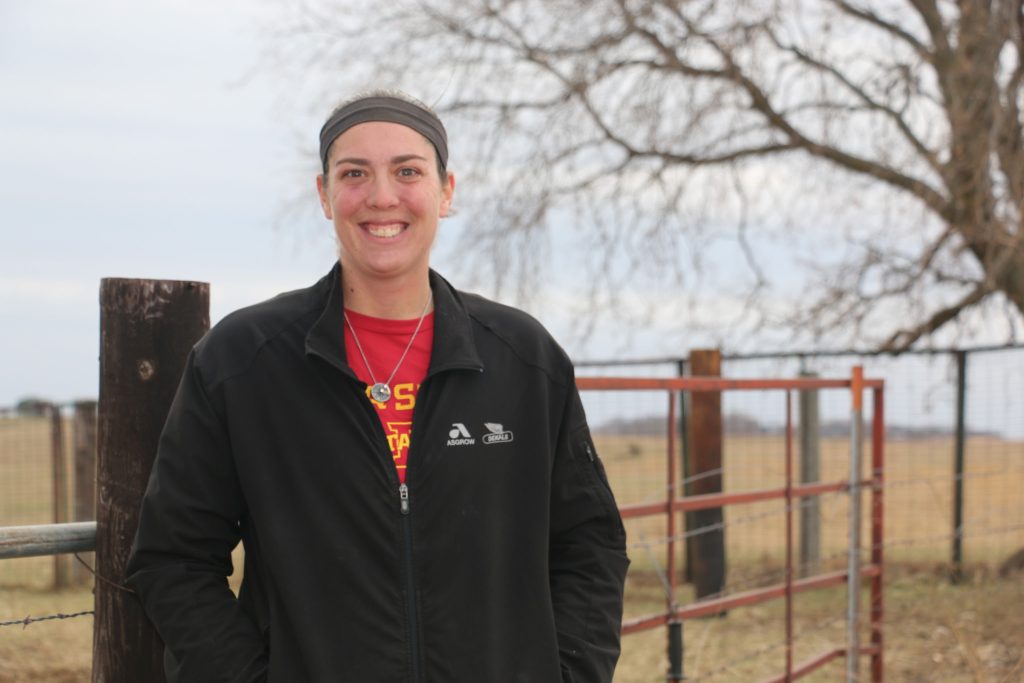
A New Generation of Conservation: Emily Boettcher Carries on Father’s Commitment to Healthy Soil
Even after growing up on a Dickinson County farm that’s been in her family since 1936, Emily Boettcher never thought she’d become a farmer. She got her degree in sociological justice from Northwestern College and planned to become a police officer.
But in 2009, as Boettcher struggled to find work and a longtime farm employee retired, her dad made her an offer: Come home and help out on the 650-acre farm for a year.
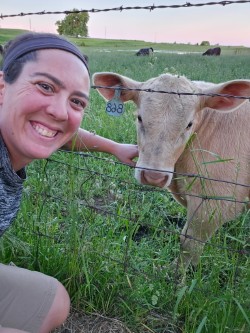
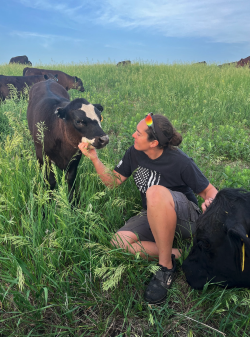
Those 52 weeks transformed into a career – plus a lifestyle built on beef cattle, a thriving seed business, and a growing passion for conservation.
The Boettcher family farm sits on a hill in the watershed table of Big Spirit Lake. That water table is close to the surface and is heavily tiled. The soil derived from clay, silt, sand, and gravel left by retreating glaciers is highly fertile, but it also drains poorly.
Boettcher’s conservation focus comes from her dad, who was an early adopter of strip tilling in the 2000s.
“We knew erosion was a problem,” Boettcher said. “Strip till was a way to move less soil, lose less soil, and still grow strong crops.”
She said that while it took a few years for the farm operation to see the benefits of strip tilling, the practice brought a new level of efficiency and soil protection. The success they saw from strip tilling encouraged them to try other conservation practices.
In 2012, Boettcher and her dad started planting cover crops in their fields. Figuring out what worked for their operation took some trial and error, including interseeding and planting after beans were taken out. Boettcher said they originally covered all their crop fields in cover crops, but the weather made it difficult to get the cover crops killed in April. This year, she and her father put cover crops on their corn ground, which is about half their acres.
“We’re seeing better growth and better emergence in our cover crop fields,” she said. “You can see how much healthier the corn looks.”
Boettcher said she’s noticed better infiltration of water and that the soil is able to hold water where it’s needed rather than allowing it to wash to the bottom of the hill.
Living near the Iowa Great Lakes fuels Boettcher’s drive for conservation. She’s taken that passion a step further as a commissioner on the local soil and water conservation board, where her job is to educate her fellow farmers about how practices like cover crops, buffer strips, waterways, and prairie strips make a difference on local farmland.
“Water quality is huge for tourism and wildlife in this part of the state, but also for us,” she says. “Better water and better feed means healthier cattle. And the more we can do to prevent nitrates and pollution, the better.”
Boettcher and her dad have installed several waterways on their land with plans to add more.
They also do regular soil testing to see what is needed in their fields. Alfalfa rotations on highly erodible hillsides and a solar well have dramatically improved cattle growth. They’ve worked with FSA cost-share programs to implement various practices.
Boettcher said she is proud that she has been able to see the benefits of conservation.
“My dad has shown me that the practices we do allow us to build the crops we get,” she said. “Each year, we seem to do really well at keeping our yields up there with people around us. It is possible to be conscious of conservation and still farm and do well.”
Her advice for farmers looking to get into conservation? Start small with strip-till or no-till.
“Try it on 80 acres and get a feel for what the weather does in your area,” she said. “You’re putting all that fertilizer right on that row, and that corn just has to put its roots down and get to it.”
She added that it will likely take more than one year to figure out what works for your farm, but with smart experimentation, the system should start proving itself.
With her dad planning to retire in the next few years, Boettcher remains committed to the farm’s long-term mission: Keep building soil health, protect water quality, and grow a sustainable operation for the next generation.
“Dad has always said we have to take care of the soil, or the next generation won’t have the same land we do,” she said. “There aren’t many small farmers left, but they still feed the world. You can be small and still make a big impact.”