
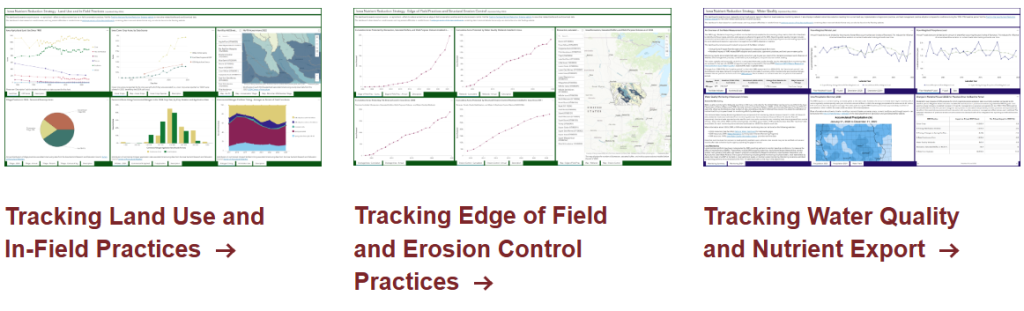
Recently, the Iowa Nutrient Reduction Strategy Interactive Dashboards received an update with 2024 data. With nearly every data set showing an improvement, here are some highlights from two of the updated dashboards, “Land Use and In-Field Practices” and “Edge-of-Field Practices and Structural Erosion Control.”
If you’re interested in exploring the data for yourself, visit the Iowa Nutrient Reduction Strategy tracking page.
Some of the really exciting wins came from the edge-of-field data, showing a marked increase in protected acres. Practices such as saturated buffers, bioreactors, oxbows, and wetlands, as well as innovative efforts from some of our partners, all contributed to this.
Specifically, in the “Cumulative Acres Protected by Bioreactors, Saturated Buffers, and Multi-Purpose Oxbows Installed in Iowa Since 2006” category, we see that these practices covered 18,000 acres in 2023, and jumped a whopping 38% to protect 24,800 acres in 2024. We see a similar trend in “Cumulative Acres Protecting Tile Drained Land in Iowa Since 2003,” with a 14% gain from ’23 to ’24. These acres increased from 167,700 to 190,600 in just one year.
This massive increase is likely due to efforts such as batch and build catching on across the state, allowing multiple edge-of-field structures to be installed in a group and cutting through loads of red tape. Combined with support from IDALS, DNR, and state/local NRCS offices, these edge-of-field practices are poised to continue protecting water quality on more acres.
On the in-field and nutrient-management fronts, we also saw notable improvements. Cover crop acres were up again in 2024, though less than the year-to-year trend would predict. From ’23 to ’24, we saw an increase from 3.8 million to 3.9 million, about 100,000.
While slower than expected, an increase of 100,000 acres is nothing to scoff at. Using average nitrate loss and practice effectiveness rates, we can see that this will keep an extra 840,000 pounds of nitrate on farm fields. Not bad! It can also be inferred that many early adopters have now taken on cover cropping, and the year-to-year trend will slow a bit as we reach the middle and late adopters.
More good news comes from the “Commercial Nitrogen Fertilizer Timing” dataset, where we see a decrease in fall anhydrous without N inhibitor from 7.6% to 6%, and an increase in spring pre-plant anhydrous from 36% to 43%. This is a positive shift for water quality, as farms are moving away from fall application. This method carries a high risk of runoff and nutrient loss compared to spring application, especially when used without an N inhibitor.
These trends show that conservation efforts in Iowa are truly making an impact and that farmers across the state are continuing to implement practices that protect Iowa’s soil and water. If you’re interested in learning more about conservation practices, or are looking for a place to get started, visit the Conservation Compass, where IAWA has numerous free resources to help find the right solution for your farm.