
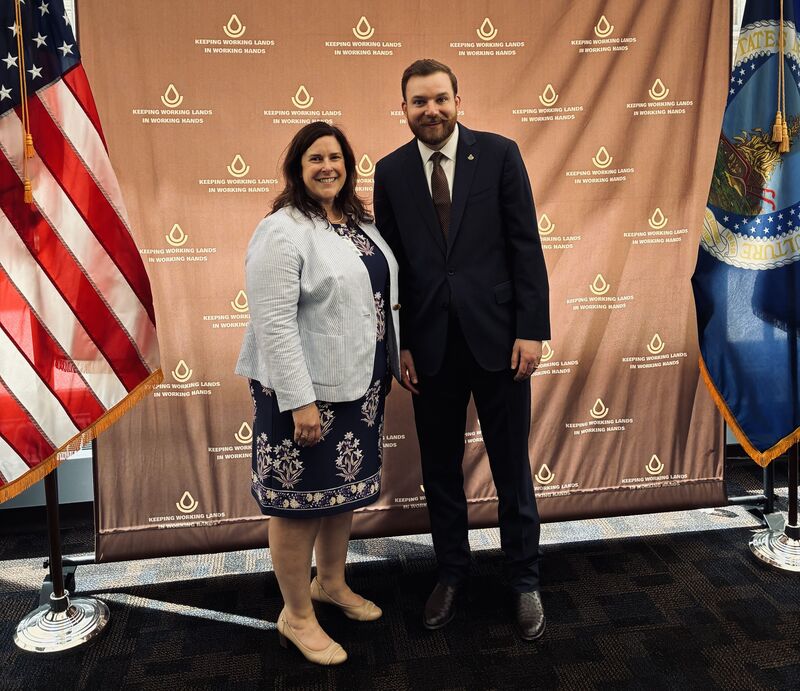
WASHINGTON D.C. (July 14, 2026) – Susan Kozak, Division Director at the Iowa Department of Agriculture and Land Stewardship (IDALS), recently traveled to Washington D.C. to advise USDA’s practice standards for conservation.
Kozak is the Division Director for IDALS and also serves as the Vice President of the National Association of State Conservation Agencies. She also attended the swearing-in of the 19th Chief of NRCS.
Practice standards are one of the most important behind-the-scenes documents for conservation in the U.S. They determine what counts as a conservation practice, how it is implemented, and whether a farmer is eligible for funding to help with the practice.
Why it matters: Practice standards make sure conservation is effective.
- For example, a cover crop isn’t automatically a best practice for conservation. In order for it to have the most positive impact on nutrient and soil loss prevention, it needs to be planted at the right time, be the right species to support soil health, and be terminated correctly.
Why farmers should care: Standards can determine things like
- If you’re eligible for funding
- What requirements you’ll have to complete
- How you can install or maintain the new practice on your farm if you sign up
Standards are usually updated on a five-year rotation, but can be changed earlier when new research or technologies warrant change.
NRCS is looking to update standards on 32 practices in 2026.
An update to the livestock pipeline standard (516) would allow collapsible lay-flat tubing for livestock watering systems. NRCS officials say this provides an option that is lower cost, easier to move or replace, and can be helpful for temporary or seasonal grazing.
No changes have been recommended that impact the most popular practices in Iowa such as cover crops, nutrient management, no-till, wetlands, and edge-of-field practices.